24hr Family Helpline: 07511 208429
Mainline: 01708 734366

Childhood cancer diagnosis

Types of Cancer

To find out if your child has cancer and, if so, what type of cancer they have health professionals will assess your child and their symptoms, and carry out important tests.

When your child has symptoms that could be caused by cancer, they will be referred by their GP or local hospital to one of the following specialists:

  • a paediatrician, who specialises in treating children.

  • a paediatric oncologist, who specialises in treating children with cancer.

  • a paediatric haematologist, who specialises in treating blood disorders.

Various tests and scans will be carried out to diagnose your child’s illness and to monitor your child throughout their treatment.

  • Dr-and-child-line

Why are tests carried out?

Tests after a confirmed diagnosis

Once a diagnosis has been confirmed, further tests may be needed before treatment begins. This may mean that treatment doesn’t start until a few days later, however generally cancer develops slowly, therefore delaying the start of treatment for a short time won’t make it less effective.

It is more important that your doctor is certain about the type of cancer your child has and whether it has spread in their body because this information will help your doctor choose the most effective treatment.


Types of tests for childhood cancer

The most common tests used for the diagnosis of childhood cancer, as well as to monitor the success of treatment or to identify side effects of treatment, include:

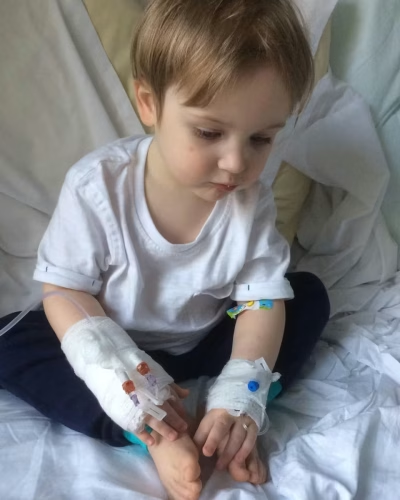
  • PHOTO-2021-07-22-13-16-07

Staging

The stage of a cancer means the size of the tumour and whether or not it has spread beyond where it started in the body. Knowing the extent of the cancer helps doctors decide on the best treatment for your child.

Staging applies to nearly all cancers apart from leukaemia.

Generally, cancer is divided into four stages:

  • Stage 1 – the cancer is still small and only visible in one place in the body;

  • Stage 2 or 3 – the cancer has spread into other parts of the body close to where it started;

  • Stage 4 – the cancer is large or may have spread to other parts of the body.

If the cancer has spread to distant parts of the body it is known as secondary or metastatic cancer.

Important Notice

This page is intended to back up the information you get from the hospital, not to replace medical advice from a consultant.

Information last reviewed on 14th January 2026.
Based on information originally produced by Children’s Cancer and Leukaemia Group (CCLG), Accessed 2022.

Find out more about childhood cancer

  • 3-hands-childhood-cancer-ribbon

Get in touch

We understand that this can be a very overwhelming time for your family.

If you have any questionns, concerns or simply feel you would like somene to talk to – please do not hesitate to contact us – we will be happy to help.